



Your rotator cuff powers your most basic daily routines. It works when you get dressed, reach for morning coffee, or lift objects overhead. Because this structure is so vital for mobility, it is highly vulnerable to damage. In fact, rotator cuff tears are the most common tendon injuries treated by orthopedic specialists.

Anatomy of the Rotator Cuff
The shoulder is a ball-and-socket joint. It connects three bones:
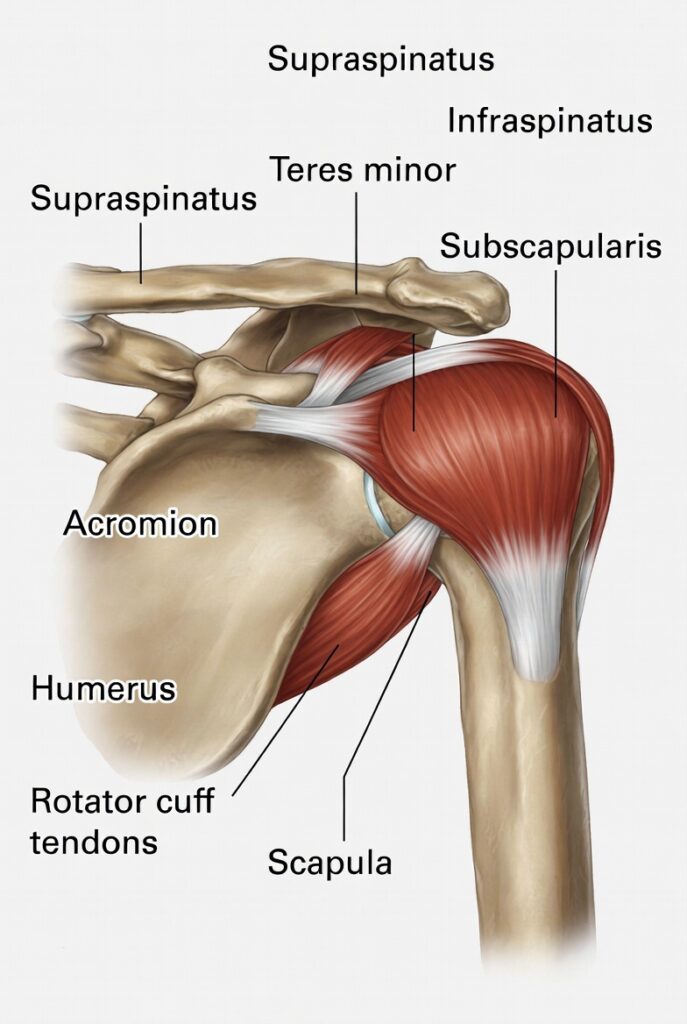
- Humerus (upper arm bone)
- Scapula (shoulder blade)
- Clavicle (collarbone)
The head of your humerus fits into a shallow socket in the shoulder blade. A capsule of four muscles and connecting tendons wraps tightly around the humerus to stabilize the joint:
- Supraspinatus: Lifts your arm upward.
- Infraspinatus: Rotates your arm outward.
- Teres Minor: Assists with outward rotation.
- Subscapularis: Stabilizes the arm and rotates it inward.
When these tendons stretch, fray, or snap, simple shoulder movements become painful.
Common Signs and Symptoms of a Tear
Rotator cuff injuries range from partial-thickness tears (frayed tissue) to full-thickness tears (tendons completely detached from the bone). Look out for these common warning signs:
- Night pain: A deep, dull ache that worsens when sleeping on your side.
- Overhead pain: Sharp twinges when combing hair or reaching behind your back.
- Weakness: Difficulty lifting objects or a catching sensation during movement.
- Crepitus: Cracking, grinding, or popping sounds when moving your shoulder.
DEGENERATIVE VS. ACUTE TEARS
Degenerative Tears: Wear and Tear
Most tears develop slowly over time. As we age, natural blood supply to tendons decreases. This slows down the body’s ability to repair micro-tears. Repetitive motions like throwing, painting, or rowing accelerate this breakdown. Many age-related tears cause no symptoms initially, showing pain only after inflammation sets in.
Acute Tears: Sudden Injury
Acute tears happen instantly from a specific trauma. Examples include falling on an outstretched hand or lifting an excessively heavy object. These injuries often occur alongside shoulder dislocations or collarbone fractures. Prompt orthopedic evaluation is critical. Delaying care can cause muscle wasting or tendon retraction.
How Are Rotator Cuffs Treated?
Treatment depends on tear severity, your age, and your activity goals.
Non-Surgical Management
Conservative care works well for partial tears or age-related wear. Most patients find relief within 6 to 12 weeks using a tailored plan:
- Physical Therapy: Strengthens surrounding muscles to compensate for the injury.
- Cortisone Injections: Delivers powerful, temporary relief from local inflammation.
- Activity Modification: Pauses overhead lifting to let the tendon heal.


Advanced Surgical Options
Surgery may be necessary if conservative care fails or if you have a full-thickness acute tear. Surgeons often use arthroscopic rotator cuff repair. This minimally invasive procedure uses tiny incisions and a camera to anchor the torn tendon back to the bone.
Expert Orthopedic Care in the Fox Valley
Ignoring shoulder pain can lead to chronic stiffness or frozen shoulder. At Fox Valley Orthopedics, our shoulder specialists use advanced diagnostics to find the exact location of your tear. We then build a recovery plan tailored to your lifestyle.